In this article
The Pen Comes Out Under Fire
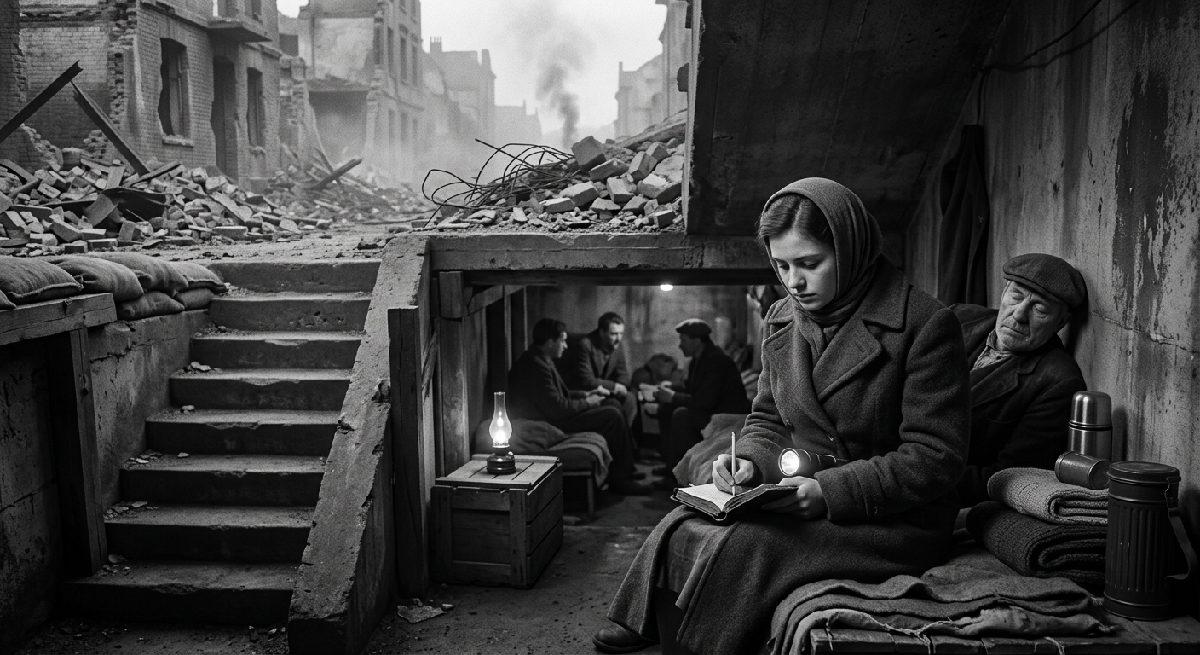
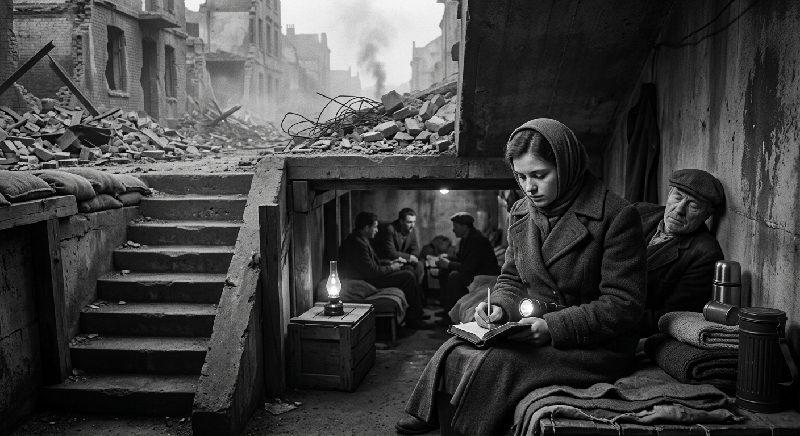
When Russia invaded Ukraine, people ran for shelter - and then, in the dark, many sat down to write. Nearly 1,500 civilians did it during the war itself. Eighty years earlier, hundreds of ordinary Britons did the same as the bombs fell. A paper notebook, a smartphone, two different wars, one strange reflex: when the ground shakes hardest, we write it down. The question is why - and the first clue is stranger than it sounds.
The Pen Comes Out Under Fire
Here is something I keep turning over.
When Russia invaded Ukraine in early 2022, sirens went off across the country. People grabbed what they could and ran for shelter. Trains out of the cities were packed. Nobody knew what the next day held.
And in the middle of all that, a lot of people sat down and wrote.
Not afterward. Not once it was safe. During. In basements. Between sirens. On phones, in the dark.
One group of researchers later gathered written accounts from nearly 1,500 Ukrainian civilians. The writing came in over almost two years, while the war kept going. People wrote what they saw, what they lost, what frightened them most.
The researchers even measured how much the writers were hurting. They scored each account for signs of trauma - and for something called moral injury. That is the specific wound of having seen, or done, things that broke your sense of what is right.
People carrying that kind of weight still chose to write.
Here is the part that stays with me. Many had never kept a diary before. They started in the worst moment of their lives.
You would think war is when writing stops. There is no quiet. There is no spare hour. There is barely a safe wall to lean against. And yet the writing went up.
Why do people reach for a pen exactly when the world is hardest to hold?
This is not a phone thing. It is not a 2022 thing. It is very old.
Go back to Britain, late summer of 1939. War with Germany was days away. A small effort called Mass Observation - a project to record ordinary daily life - sent out a quiet request. Would regular people keep a diary? No rules. No set topic. Just write down your days.
About 480 people said yes. Shopkeepers. Clerks. Housewives. None of them famous. They wrote through the bombing of cities, through years of rationing and fear.
One of them, a housewife in her late forties, wrote so faithfully and so well that her diaries later became a book, and then a film. She had simply answered the call to write down an ordinary life - right as it stopped being ordinary.
Eighty years apart. Two different wars. A paper notebook and a smartphone. The same strange reflex.
When the ground shakes hardest, people write it down.
I want to understand why. Not the noble version, where everyone is brave and wise. The real version. What is the pen actually doing for a scared person in a basement, with the power out?
That question has been studied more carefully than you might guess. And the first thing it turns up is not what I expected.
Because the urge to write does not behave the way you would think. It does not simply rise when things go bad and fade when they get better. It has a shape of its own - a strange, almost clockwork shape. And that shape is where this gets interesting.
References
- Kuperman, V., et al. (2025). The Narratives of War (NoW) corpus of written testimonies of the Russia-Ukraine war. Language Resources and Evaluation, 59(3), 2415-2426. https://doi.org/10.1007/s10579-025-09813-8
- Garfield, S. (2005). We Are At War: The Remarkable Diaries of Five Ordinary People in Extraordinary Times. Ebury Press. (Drawing on the Mass Observation Archive, University of Sussex.)
- Mass Observation Archive, University of Sussex. https://www.massobs.org.uk/
A Crisis Has a Shape
You could almost set a clock by it. After a war begins, people talk about it constantly - for two or three weeks. Then the talking falls off a cliff, even though the danger hasn't moved an inch. But the worrying doesn't stop; it just goes quiet and private. There is a measurable shape to how a shock moves through us, and it explains exactly why people keep writing long after everyone around them has gone silent.
A Crisis Has a Shape
Imagine you could measure how much a whole country is hurting. Not guess at it. Count it.
Back in the early 1990s, some researchers tried. The first Gulf War had just begun. They picked up the phone and called people, again and again, over many weeks. The questions were simple. How many times today did you think about the war? How many times did you talk about it with someone?
What they found has a clean, almost mechanical shape.
In the first two to three weeks, people talked about the war constantly. It filled every conversation. The bus stop, the dinner table, the office. Then, sharply, the talking dropped off.
Here is the strange part. The war was not over. The danger had not passed. But the talking fell away anyway, like a fever breaking.
That gap is the whole mystery. Why would people stop talking about something that is still happening to them?
The part that keeps going
Part of the answer is the people around you.
After a few weeks, everyone is tired of the same subject. There is an unspoken signal in the room: enough now, let's move on. You can feel it. So you stop saying it out loud - even though you are nowhere near done feeling it.
This is the squeeze. The world says move on. The inside of you says I can't yet. And there you are, full of something you have quietly been told to stop sharing.
The researchers saw it clearly. People stopped talking about the war after a few weeks. But they did not stop thinking about it. The worry kept running, alone, long after the conversations dried up.
There is even a name for this rise and fall. Researchers call it a social stage model - a map of the steps a community moves through after a shared blow. It tends to go like this:
- The first days - shock and action. People are too busy surviving to reflect.
- The first weeks - everyone talks about it, constantly. The whole world is one conversation.
- After that - the talk runs dry, but the private worry doesn't. People go quiet on the outside and loud on the inside.
The conversations end long before the feelings do. That gap is exactly where a private page does its work.
This matches what I see in the wartime diaries. People wrote most in the early storm. But they also kept writing once everyone around them had gone silent, worn out by the same news.
And I find that oddly comforting. It means the urge to keep writing after a crisis is not a sign that something is wrong with you. It is the most ordinary thing in the world. The conversation around you ended. The one inside you didn't. A page is simply somewhere to put it down.
But knowing when people write is not the same as knowing whether it helps. And here the research turns somewhere I did not expect - toward people who wrote not to feel better, but for a reason that is harder, and braver, than healing.
References
- Pennebaker, J. W., & Harber, K. D. (1993). A social stage model of collective coping: The Loma Prieta earthquake and the Persian Gulf War. Journal of Social Issues, 49(4), 125-145.
Sometimes You Write to Be Remembered, Not to Feel Better
Not everyone writes to feel better. In the Warsaw Ghetto, more than sixty ordinary people secretly wrote down everything - the deaths, but also the jokes and the children's games - then sealed it in milk cans and buried it under the city. They did not expect to outlive their own diaries. This is writing as witness: a refusal to vanish without a trace. And the same reflex is alive in the war diaries being written right now.
Sometimes You Write to Be Remembered, Not to Feel Better
I have been sitting with this chapter for a while, because the material is heavy. But I think it holds the truest answer to the question.
Not everyone writes to feel better. Some people write so they will not be erased.
In the Warsaw Ghetto, during the Second World War, a historian gathered a secret group around him. Their task was simple and almost unthinkable. Write everything down. What people ate. How children played. Who died, and how. The soup kitchens. The fear.
They called themselves by a quiet code name - Oyneg Shabes, "the joy of the Sabbath" - because they met on Saturdays.
These were ordinary people. Teachers. Writers. Social workers. More than sixty of them. By then, they understood what was coming for them. And they kept writing anyway.
What gets me is what they chose to save. Not only the horror. The ordinary, too. A child's game. A street song. A joke told to get through the day. As if to say: we were not only victims. We were people, with whole lives - and that is worth keeping.
When the deportations to the death camps began, the group did something extraordinary. They sealed their pages into metal boxes and old milk cans. Then they buried them under the city.
They were writing for a reader who would only arrive after they were gone.
Think about that for a moment. They did not expect to survive their own diaries. The writing was not for their own comfort. It was a message thrown forward in time - to strangers, to us.
After the war, almost none of them were alive. But searchers dug under the rubble and found the boxes. The milk cans came up out of the ground, full of pages. The voices had outlived the people.
The man who started it had left a coded note near the end, wondering whether the world would ever read what they had hidden.
It did. We are, in a small way, doing it right now.
A different reason to write
This is where my idea of journaling cracked open a little.
I had been thinking of writing as a tool for the self - a way to calm down, to sort through things, to heal. The ghetto archive is none of that. It is the opposite of private. It is writing as witness. Writing as a refusal to vanish without a trace.
And it is not only history. The same reflex is alive in the Ukraine war diaries. Researchers who studied diaries shared openly online found something striking. People were not only writing to cope. They were writing to record - to leave proof of what was done, in case anyone later tried to say it never happened.
So there seem to be at least two very different reasons a person writes in the dark.
One is turned inward. I need to get this out of my chest. The other is turned outward. Someone has to know this happened.
A lot of wartime writing is quietly doing both at once.
What I keep returning to is this. The inward kind and the outward kind are not really enemies. To write "this happened, and it happened to me" is, in the same breath, a way to survive it and a way to make it count.
Which leaves one honest question I have been avoiding. The witness writing makes sense on its own terms. But the inward kind - the writing-to-heal - does it actually work? Or do we just tell ourselves it does?
There is, at last, hard evidence on that. And it comes from soldiers.
References
- Kassow, S. D. (2007). Who Will Write Our History? Emanuel Ringelblum, the Warsaw Ghetto, and the Oyneg Shabes Archive. Indiana University Press.
- United States Holocaust Memorial Museum. The Oneg Shabbat Archive. Holocaust Encyclopedia. https://encyclopedia.ushmm.org/content/en/article/the-oneg-shabbat-archive
- Polishchuk, O. (2024). Digital war diaries: Witnessing the 2022 Russian War against Ukraine. Memory, Mind & Media, 3, e15. https://doi.org/10.1017/mem.2024.11
More by Sulabh Rastogi