
Master Your Emotions with Hurroz: Turn Thibaut Meurisse’s 4-Part Blueprint into Daily Practice

Master Your Emotions with Hurroz: Turn Thibaut Meurisse’s 4-Part Blueprint into Daily Practice

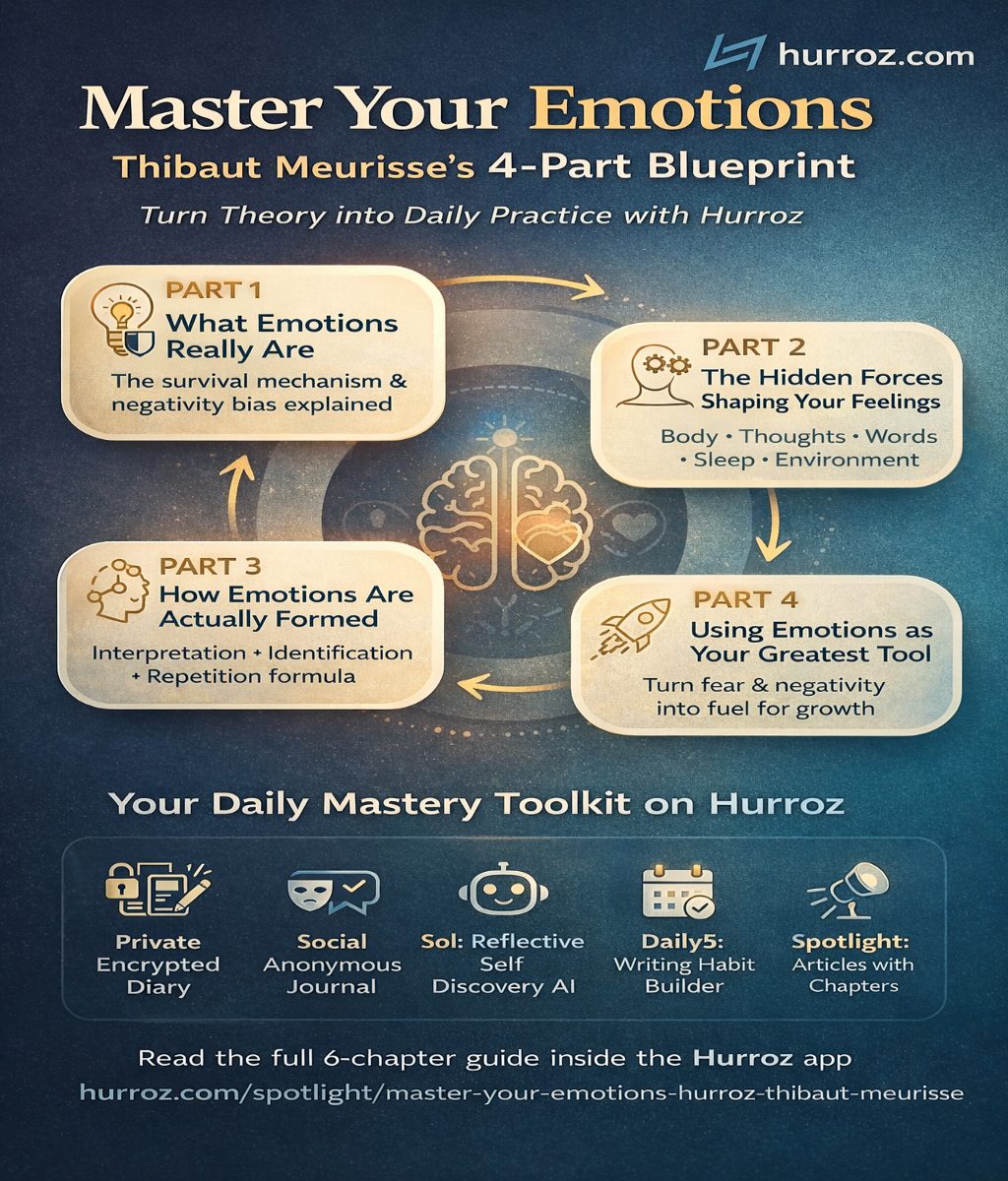
Discover how Thibaut Meurisse’s bestselling book Master Your Emotions can be turned into daily habits using Hurroz’s Private Encrypted Diary, Social Anonymous Journal, Sol Reflective AI, Daily5 writing streaks, and Spotlight articles. A complete 6-chapter guide for emotional mastery.

In this article

  1. 1. What Emotions Really Are 6 min
  2. 2. The Hidden Forces Shaping Your Feelings 5 min
  3. 3. How Emotions Are Actually Formed 3 min
  4. 4. Using Emotions as Your Greatest Tool for Growth 9 min
  5. 5. From Book to Real Life — How Master Your Emotions Connects Perfectly with Hurroz Features 3 min
Chapter 1

What Emotions Really Are

Discover why emotions exist as an ancient survival mechanism and how your brain’s negativity bias still runs the show today.

What Emotions Really Are

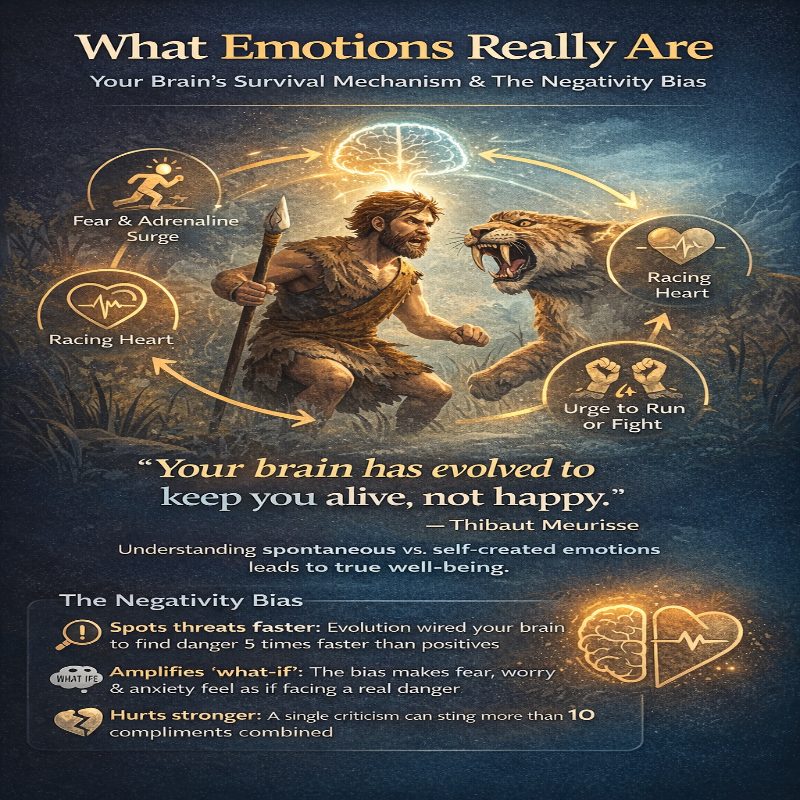
Before we can master our feelings, we must first understand what they truly are. Your brain’s first priority is not happiness but survival. Imagine the beginning of human history: hunters facing a saber‑toothed tiger. Their split‑second emotional response included instant fear, a racing heart, an adrenaline surge, and the urge to run or fight. That same response still runs in our brains and keeps us safe.


Consider the great naturalist Charles Darwin. In 1838, Darwin visited the London Zoo and found himself standing in front of the glass enclosure of a highly venomous puff adder. Intrigued by human instinct, he decided to run an experiment on himself. He pressed his face close to the glass and vowed not to move when the snake struck. Yet, the moment the adder lunged with open fangs, Darwin instantly threw himself backward.


His rational mind knew there was a thick layer of glass protecting him. But his ancient, emotional brain didn’t care about logic; it cared about keeping him alive. Darwin documented this phenomenon in his 1872 book, The Expression of the Emotions in Man and Animals, writing that his will and reason were powerless against the imagination of a danger he had never even experienced. [1] This is spontaneous emotion in its purest form—offering instant protection and producing real fear when the brain perceives danger.


The Negativity Bias

Our brain is wired with a powerful negativity bias and can spot threats five times faster than positives. Evolutionary psychologists and neuroscientists have long documented that negative events elicit more rapid and prominent responses than non-negative ones [2]. A single criticism can hurt us more than ten compliments combined. The what‑if factor makes us worry as if facing a real danger. This bias was very helpful for survival in early ages, but today it creates more anxiety and stress.


The author Mark Twain brilliantly captured this evolutionary glitch. Toward the end of his life, Twain is widely quoted as observing:

"I am an old man and have known a great many troubles, but most of them never happened." [3]


Twain was a victim of the "what-if" factor. He famously suffered from intense bouts of anxiety, bad investments, and deep rumination about the future. He spent immense energy fighting phantom tigers. As the author Thibaut Meurisse puts it in his work on emotional mastery: “Your emotions exist for a reason, even the negative ones. Your brain has evolved to keep you alive, not happy.” [4] Understanding the difference between spontaneous emotions and self‑created emotions is what leads to greater well‑being.


Spontaneous emotions offer instant protection; they produce real fear when we are in danger. Self‑created emotions are the ones we build with our thoughts and stories. Rumination, worry, and regret are byproducts of this process.

We must understand that emotions are never the enemy. They are neutral signals. Fear makes us protect ourselves. Anger signals that a boundary has been crossed. Sadness signifies that something valuable is missing. Joy tells our brain to do more of what produced it.


Nelson Mandela’s 27 years in a South African prison offer the clearest modern mirror. Robbed of freedom, dignity, and decades of his life, he felt the full force of anger and grief. Those emotions were not noise—they were data. Anger said, “A boundary of basic humanity has been violated.” Sadness said, “Something precious—justice, family, nation—has been taken.” Mandela refused to let negativity bias turn those signals into endless bitterness or revenge fantasies. Anger toward injustice was natural, yet Mandela eventually transformed that emotion into a force for reconciliation instead of revenge. When he walked free in 1990 and became president in 1994, South Africa survived its most dangerous transition without civil war.


When we stop fighting our emotions and start listening, everything changes for the better. This small shift brings true happiness. This is the real foundation of emotional mastery.


A Story of Fear and Survival


In 1914, the explorer Ernest Shackleton launched what many believed would be the greatest expedition of the age: crossing the Antarctic continent on foot. His ship, Endurance, carried twenty-seven men into the frozen waters of the Weddell Sea. At first the voyage progressed smoothly. But as the ship pushed deeper into Antarctic waters, the ice began closing around them.


By January 1915, the Endurance was trapped in thick pack ice. The crew waited patiently, hoping the shifting seasons would free the ship. Massive slabs of frozen ocean began squeezing the wooden hull as the ice tightened its grip. Crew members later described hearing the terrifying sounds of the ship’s timbers bending and cracking in the frozen darkness.


We can imagine the emotional atmosphere in that moment when twenty eight men were stranded in one of the harshest environments on Earth. With temperature below freezing and thousands of miles from rescue, our survival instincts would immediately activate. Fear is unavoidable.


Shackleton understood that panic spreads quickly in groups under extreme stress. So he organized routines with scheduled work. He maintained shared meals and even arranged games to keep morale stable.


Then, in October 1915, after almost nine months, the ice finally crushed the Endurance. The ship slowly broke apart and sank beneath the frozen sea. At that moment, fear could easily have turned into despair but Shackleton kept the group focused on survival.


For months the crew camped on drifting ice and later they escaped using lifeboats across freezing waters. Eventually Shackleton and its crew sailed more than 1,300 kilometers across the Southern Ocean in a small open boat to reach help.


Against overwhelming odds, every member of the expedition survived (Lansing, 1959). What saved them was not the absence of fear but the ability to experience fear without allowing it to become panic. [5]


In Hurroz, open Sol: Reflective Self Discovery AI or your Private Encrypted Diary right now. Write one line: “Today my strongest emotion is signalling…” Let the ancient survival system speak. Five minutes a day with Daily5 is all it takes to turn that 100,000-year-old wiring from a source of stress into your greatest ally.


References & Notes

  1. Darwin, C. (1872). The Expression of the Emotions in Man and Animals. London: John Murray. (Darwin’s reflections on his reactions to the puff adder at the Zoological Gardens perfectly illustrate the disconnect between rational thought and evolutionary reflexes).
  2. Baumeister, R. F., Bratslavsky, E., Finkenauer, C., & Vohs, K. D. (2001). "Bad is stronger than good." Review of General Psychology, 5(4), 323-370. (This is the seminal psychological paper establishing that human brains process negative information more thoroughly than positive information).
  3. Twain, M. This quote is widely attributed to Twain in psychological and mindfulness literature to illustrate the burden of anticipatory anxiety, though its exact origin in his letters is debated among historians.
  4. Meurisse, T. (2018). Master Your Emotions: A Practical Guide to Overcome Negativity and Better Manage Your Feelings. (A foundational modern text on decoupling identity from emotional responses).
  5. Lansing, A. (1959). Endurance: Shackleton’s Incredible Voyage. New York: McGraw-Hill. (Historical account of Shackleton’s Antarctic expedition and the psychology of survival under extreme conditions.)


Foundation of emotional mastery
Chapter 2

The Hidden Forces Shaping Your Feelings

Learn the 5 invisible forces (body, thoughts, words, sleep & environment) that quietly control how you feel every single day.

The Hidden Forces Shaping Your Feelings

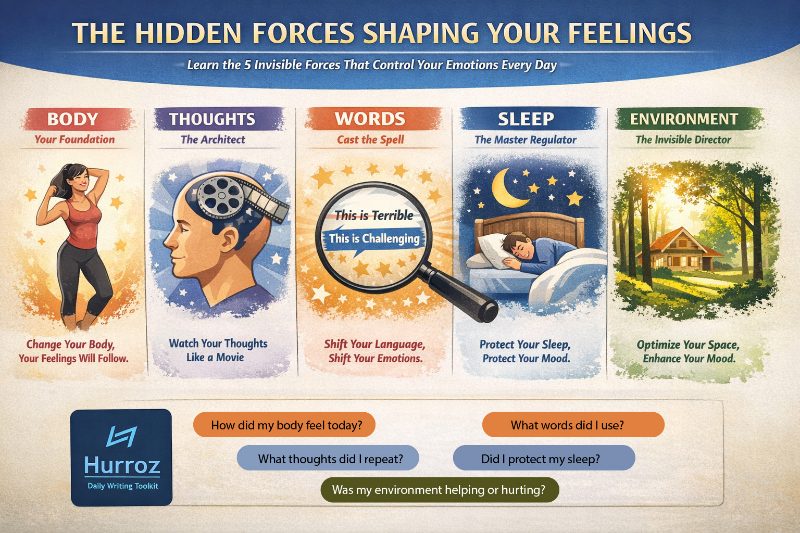
Meurisse reveals the surprising truth: **you are not at the mercy of your emotions** — five powerful forces are quietly shaping them every single day.


In this chapter, we will learn to gain control of these five forces and master them.


  • Our body is the foundation
  • Our thoughts are the architect
  • Our words caste the spell
  • Our sleep cycle resets to neutral
  • Our environment is the invisible director


a 19-year-old Harvard student named Amy Cuddy in 1992. A terrible car accident left her with a traumatic brain injury. Doctors told her she might never finish college. Her IQ dropped. Confidence shattered. She felt stupid, small, and powerless. Every time she walked into a lecture hall she slumped, crossed her arms, made herself tiny — exactly the posture her brain was now wired to associate with defeat.


Years later, as a social psychologist at Harvard, Cuddy began studying what she had lived. She asked volunteers to adopt “power poses” for just two minutes — hands on hips like Wonder Woman, chest open, chin up. Testosterone rose. Cortisol dropped. The same people then performed better in high-stakes interviews and negotiations. The body had literally changed the brain’s chemistry before a single word was spoken. Cuddy’s own life proved it: by deliberately changing her posture before every talk, the woman once told she was “not smart enough” for Harvard became one of the most-watched TED speakers in history. Her 2012 talk has been viewed over 70 million times. The ancient wiring Meurisse talks about works both ways — slump and you feel defeated; stand tall and the emotion of power follows. [1]


Our physical state is the primary driver of emotions. Poor posture without body movement can lead to anxiety and stagnant low mood. Meurisse’s rule is simple:

Change your body first, your feelings will follow.


Long before modern psychology mapped the brain-body connection, the great American philosopher William James proposed a radical idea in 1884. He argued that we don't cry because we are sad; we are sad because we cry. He believed the physical action precedes the emotion. [2]


Consider the life of Theodore Roosevelt. As a child, Roosevelt was fragile, severely asthmatic, and plagued by physical weakness and fear. Instead of accepting this fate, his father challenged him to "make his body." Roosevelt threw himself into boxing, hiking, and weightlifting. By transforming his physical posture and capability, he completely rewired his emotional baseline, transforming from a fearful boy into one of the most famously exuberant and fearless figures in American history.


Every emotion starts with a thought. Our interpretation of situations can trigger completely different feelings. We must learn to watch our thoughts like a movie instead of believing every one of them.


During World War II, Frankl was imprisoned in Nazi concentration camps under unimaginably brutal conditions. Yet he noticed something extraordinary: prisoners who could reinterpret their suffering by seeing meaning or purpose in survival maintained stronger psychological resilience.


Frankl later wrote:

“Everything can be taken from a man but one thing: the last of the human freedoms—to choose one's attitude in any given set of circumstances.” [3]


The external situation remained the same but the interpretation changed the emotional outcome. One bad night of sleep can make neutral events feel threatening. Meurisse calls sleep “the master regulator of emotions.” Protect it like your most valuable asset.


Neuroscientific research shows that sleep deprivation increases activity in the brain’s emotional centers—particularly the amygdala—while weakening the brain’s rational control systems. [4]


Our surroundings constantly feed our brain data. A cluttered room leads to cluttered mind. Staying around toxic people amplify the negativity. Nature and sunlight naturally boost your mood. When we improve our environment, we enhance our emotional state.


In 2009, a young Japanese woman named Marie Kondo had reached breaking point from her obsessive tidying. She had spent years cleaning relentlessly, yet her own room — and her mind — still felt chaotic. One afternoon, exhausted and discouraged, she collapsed onto the floor of her room and fell asleep as if passed out. When she woke, she heard an inner voice: “Look at the things that spark joy.”


She began thanking every object before letting it go. She folded clothes so they stood upright like happy soldiers. She transformed her tiny Tokyo apartment into a calm sanctuary. The emotional shift was immediate. Anxiety melted. Clarity returned. Clients started begging for her help. Her book The Life-Changing Magic of Tidying Up sold millions and sparked a global movement. Kondo proved what Meurisse teaches: the environment is the invisible director. Change the stage and the emotions playing out on it change too. [5]


The Action Checklist

  1. To gain control over these five forces, use this daily review:
  2. Body: How did my body feel today? Did I move and hold myself with intention?
  3. Thoughts: What thoughts did I repeat? Did I watch them, or did I blindly believe them?
  4. Words: What words did I use? Did I cast spells of panic or resilience?
  5. Sleep: Did I protect my sleep as my master regulator?
  6. Environment: Was my environment helping or hurting my emotional state today?


References & Notes

  1. Cuddy, A. (2012). Your body language may shape who you are. TEDGlobal. (Cuddy’s research and personal story from her 1992 car accident demonstrate how two-minute power poses alter hormone levels and emotional state; expanded in her 2015 book Presence).
  2. James, W. (1884). "What is an Emotion?" Mind, 9(34), 188-205. (The foundational text of the James-Lange theory of emotion, establishing that physiological arousal precedes the conscious experience of emotion).
  3. Frankl, V. (1946). Man’s Search for Meaning. Beacon Press. (Classic work showing how interpretation shapes emotional resilience.)
  4. Walker, M. (2017). Why We Sleep: Unlocking the Power of Sleep and Dreams. Scribner. (Explains the neuroscience of sleep and emotional regulation.)
  5. Kondo, M. (2014). The Life-Changing Magic of Tidying Up: The Japanese Art of Decluttering and Organizing. Ten Speed Press. (Kondo’s personal breakdown from obsessive tidying and the “spark joy” epiphany that followed; further detailed in her 2016 book Spark Joy and 2016 interviews).
  6. Meurisse, T. (2018). Master Your Emotions: A Practical Guide to Overcome Negativity and Better Manage Your Feelings. (Foundational text on the five forces shaping emotions).
Control Your Emotions
Chapter 3

How Emotions Are Actually Formed

The exact formula that creates every strong emotion — Interpretation + Identification + Repetition. Learn how to spot the process in real time and start weakening unhelpful feelings today.

How Emotions Are Actually Formed

Now that we understand the hidden forces that influence our emotions, lets go deeper into the precise mechanism that actually creates every emotion we feel.


Meurisse gives us a crystal-clear formula:

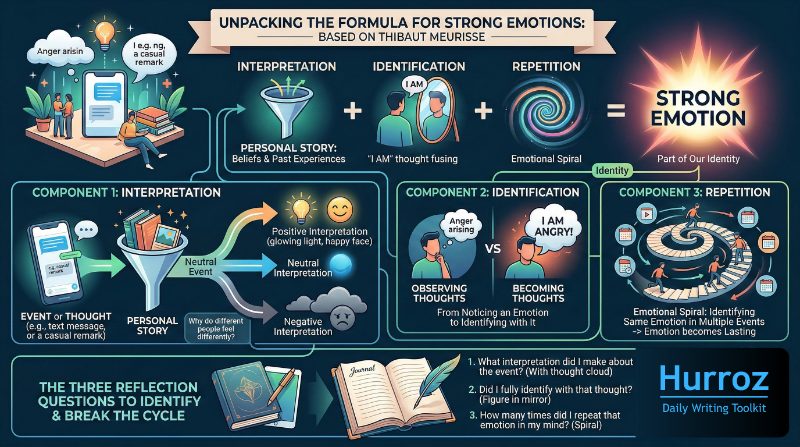
Interpretation + Identification + Repetition = Strong Emotion.


Why do some emotions grow so powerful that they start to feel like a completely different version of ourselves. Why does the same event trigger completely different feelings in two different people.


On a freezing December night in 1914, Thomas Edison stood watching his massive West Orange laboratory complex burn to the ground. Flames devoured ten buildings, millions of dollars in equipment, and years of irreplaceable prototypes. When his 24-year-old son Charles found him amid the chaos, heart pounding with dread, Edison turned with a calm smile and said, “Go get your mother and all her friends. They’ll never see a fire like this again.” The next morning he told his staff with unshakable resolve, “There is great value in disaster. All our mistakes are burned up. Thank God we can start anew.” Within three weeks the ruins had been cleared and the laboratory was humming again, larger and more modern than before. In that moment Edison had taken an event of pure devastation and interpreted it not as catastrophe but as an exhilarating invitation to begin afresh. [1]


Our interpretation of the emotions begins when we interpret an event or a thought through our personal story. Our beliefs and past experiences give us a meaning and context to the present situation.


While the event could be neutral, our interpretation could turn it into positive, negative or keep it neutral. Instead of observing our thoughts, we start becoming it. Instead of noticing anger arising, we think, "I am angry.". This is an emotional spiral of identifying the same emotion again and again in multiple events. After enough repetition, the emotion becomes lasting and feel like a part of our identity.


The tragic historical figure of Sir Richard Owen perfectly illustrates the destructive culmination of this exact emotional spiral. In the mid-nineteenth century, Owen was widely considered one of the most brilliant biologists in the world, credited even with coining the word "dinosaur." However, when Charles Darwin published On the Origin of Species, Owen interpreted the younger scientist's monumental success as a direct, humiliating assault on his own life's work. Instead of simply observing his initial feelings of professional jealousy, Owen entirely fused his identity with his resentment. He ceased to be a scientist observing his anger and simply became the anger itself, launching decades of obsessive, anonymous attacks against Darwin and his colleagues. Through relentless repetition of this perceived slight, his bitterness hardened into a permanent trait, entirely eclipsing his own scientific legacy and leaving his identity consumed by an emotion he originally manufactured. [2]


We must ask ourselves these three questions in order to identify these emotions.

  1. What interpretation did I make about the event?
  2. Did I fully identify with that thought?
  3. How many times did I repeat that emotion in my mind?


By simply writing down these answers help us discover our true self. In Hurroz, open Sol: Reflective Self Discovery AI right now and speak these three questions aloud. Then step into your Private Encrypted Diary and answer them with unflinching honesty. Commit to one single reflection each day with Daily5—five minutes is all it takes to interrupt the ancient formula before it writes the next chapter of your emotional life.


References & Notes

  1. Newton, J. (1987). Uncommon Friends: Life with Thomas Edison, Henry Ford, Harvey Firestone, Alexis Carrel, and Charles Lindbergh. Mariner Books. (Drawing on Charles Edison’s firsthand account and contemporary reports, including The New York Times coverage of the 1914 West Orange fire and the rapid rebuilding that followed).
  2. Cadbury, D. (2000). The Dinosaur Hunters: A True Story of Scientific Rivalry and the Discovery of the Prehistoric World. Fourth Estate. (Cadbury documents the intense, identity-consuming rivalry of Richard Owen, detailing how his repetitive rumination on Darwin's success permanently altered his personality and historical legacy).


Write and Discover True Self
Chapter 4

Using Emotions as Your Greatest Tool for Growth

Transform fear, anger, sadness, jealousy, guilt and even depression into powerful fuel for personal growth and meaningful action.

Using Emotions as Your Greatest Tool for Growth

We now know what emotions are, what shapes them, and exactly how they form.

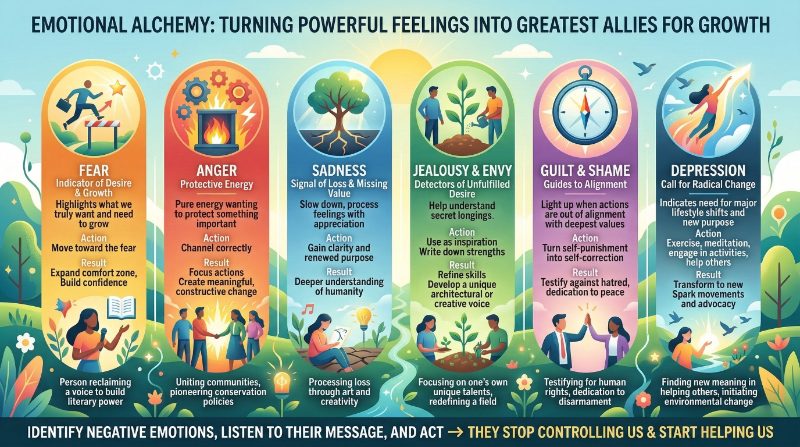
Let’s delve deeper into how our emotions, even the powerful ones, can become our greatest allies for growth. Instead of trying to eliminate negative feelings, Meurisse teaches us to listen to them, understand their message, and channel their energy into positive action.

Fear — It is not a stop sign; it is a growth indicator. Whenever we feel fear, it highlights what we truly want and where we need to grow. When we move toward the fear, we expand our comfort zone and build confidence.


Following a horrific childhood trauma at the age of seven, civil rights activist Maya Angelou became convinced that her own voice was literally lethal. Paralyzed by an overwhelming, all-consuming fear of speaking, she remained entirely mute for five years. She could have allowed that terror to dictate a lifetime of silence. Instead, she recognized that her fear of words was actually a testament to their immense, earth-shattering power. By slowly, deliberately moving toward the very thing that terrified her most, she expanded her psychological boundaries and transformed herself into one of the most resonant, fearless, and globally celebrated voices of the modern era. [1]


Anger — It is pure energy that wants to protect something important. When we channel it correctly, it helps focus our actions and create meaningful, constructive change.


To understand the constructive furnace of anger, we must look to Chico Mendes, a humble rubber tapper in the remote Amazon basin of Brazil. In the 1980s, Mendes watched as massive cattle ranchers and logging syndicates began violently burning the rainforest, destroying the delicate ecosystem that sustained his community. His early activism was defined by a profound, entirely justified rage at the systematic destruction of his home and his people's livelihood. Yet, if he had allowed that anger to manifest as unchecked violence, his movement would have been swiftly crushed. Instead, Mendes forged his raging indignation into a sharply honed, peaceful organizational strategy. He utilized the raw, protective energy of his anger to unite disparate indigenous tribes and rural workers, pioneering the concept of "extractive reserves" and forever altering global environmental conservation policies before his tragic assassination. [2]


The life of Ida B. Wells offers a powerful example of anger transformed into constructive action.

In the late nineteenth century, Wells began investigating the widespread practice of lynching in the American South. The brutality and injustice she documented provoked deep moral outrage.

Many journalists at the time avoided the subject, fearing backlash or violence. Wells chose the opposite path.

Her anger toward injustice became the driving force behind years of investigative work. She gathered detailed evidence, published reports, and traveled extensively to speak about the issue, even after her newspaper office was destroyed by an angry mob.

Rather than allowing anger to consume her, she directed it toward exposing truth and mobilizing public awareness.

Her writings became some of the earliest systematic documentation of racial violence in the United States. [3]

Anger, when guided by purpose, becomes a powerful force for change.


Sadness — It signals that something valuable is missing or has been lost. It invites you to slow down and process your feelings with deeper appreciation, clarity, and renewed purpose.


The physician and writer Oliver Sacks spent his career studying patients with unusual neurological conditions.

Many of his most famous case studies involved individuals whose lives had been dramatically altered by illness or injury. Instead of viewing these patients simply as clinical subjects, Sacks approached them with remarkable empathy and curiosity.

Colleagues often remarked that his work carried a quiet emotional depth. Sacks believed that illness could reveal hidden dimensions of the human mind and personality. In books such as Awakenings and The Man Who Mistook His Wife for a Hat, he explored how neurological conditions reshaped the experiences of his patients. Sadness, in these stories, was not merely suffering. It became a doorway into deeper understanding of what it means to be human. [4]


In 1925, Frida Kahlo was in a horrific bus accident in Mexico City that crushed her spine, pelvis, and leg, leaving her in lifelong pain and unable to have children. Sadness overwhelmed her as her dreams of a normal life vanished. She slowed down, processed the loss by painting her broken body and inner world, and turned that pain into art that brought her clarity, purpose, and lasting recognition in the art community. [5]


Jealousy and envy — These are detectors of unfulfilled desire. They help us understand our secret longings; we must turn them into inspired action. Write down the things you are doing better than others.


The great nineteenth-century English landscape painter John Constable openly grappled with intense envy as he watched his contemporary, J.M.W. Turner, achieve massive, sensational success and early induction into the Royal Academy. While Turner was celebrated for his flashy, dramatic historical scenes, Constable was routinely ignored, his quiet paintings of the Suffolk countryside dismissed as ordinary. It was a bitter, deeply uncomfortable emotion. But Constable did not allow his jealousy to rot into passive resentment or mimicry. He utilized it as a flawless detector of his own unfulfilled desire to capture the absolute truth of nature. He turned that envious frustration into inspired, obsessive action, furiously developing a groundbreaking, highly scientific method of painting clouds and light. He refused to copy Turner, instead leaning into what he alone did best—eventually redefining the entire trajectory of European landscape art. [6]


The architect Louis Kahn spent many years struggling to establish himself professionally. In the early decades of his career, he watched other architects achieve recognition and major commissions while his own work remained relatively obscure. Those experiences could easily have produced resentment. Instead, Kahn used them as motivation to refine his architectural philosophy. He spent years reflecting on what buildings should express—not merely functionally, but spiritually.

Eventually his work began to attract international attention. Structures such as the Salk Institute in California and the National Assembly Building in Dhaka became celebrated examples of monumental modern architecture. What began as a period of professional comparison ultimately pushed him toward developing a unique architectural voice. [7]


Guilt and shame — These are guides that light up when our actions are out of alignment with our deepest values. Treat them as loving feedback and turn self-punishment into self-correction.


After surviving Auschwitz in 1945, Elie Wiesel carried crushing guilt and shame for living while his parents and sister perished. He listened to the signal, treated it as loving feedback, and turned self-punishment into self-correction by writing Night and spending his life testifying against hatred. His work helped millions heal and strengthened Holocaust education and human-rights efforts around the world. [8]


Perhaps the most striking modern example of shame functioning as an immediate moral compass is the story of the Polish-British physicist Joseph Rotblat. During World War II, Rotblat was brought into the highly secretive Manhattan Project to help develop the first atomic bomb, driven by the fear that Nazi Germany might build one first. However, when it became clear that Germany had abandoned its nuclear program, Rotblat realized the weapon was being built for entirely different, catastrophic geopolitical reasons. Working on an instrument of such unprecedented mass slaughter triggered a profound, agonizing wave of moral shame. Instead of defensively masking his guilt or deferring to military authority like his peers, Rotblat treated this agonizing emotion as urgent feedback from his own conscience. He became the only physicist to voluntarily walk away from the Manhattan Project before the bomb was tested. He redirected his immense scientific legacy, dedicating the rest of his life to nuclear disarmament and ultimately winning the Nobel Peace Prize. [9]


Depression — It is a call for radical change. It indicates a need for major lifestyle shifts, including exercise, meditation, engaging in activities, and helping others. These transformations can bring urgently needed new meaning.


The late writer and actress Carrie Fisher experienced what she described as a crushing, inescapable darkness due to her severe bipolar disorder and chronic depression. At the height of her Hollywood fame as Princess Leia, she plunged into a devastating emotional abyss where all previous meaning evaporated completely. Rather than treating this despair simply as a shameful secret to be hidden behind the glamorous curtain of celebrity, Fisher recognized it as a violent demand for a completely different way of existing. She shifted her life entirely, using her brilliant, razor-sharp wit to write and speak about her mental illness with radical, unflinching honesty. This transformation not only saved her own life but provided urgently needed new meaning to millions of fans who finally felt seen. [10]


In the 1950s and early 1960s, Rachel Carson battled deep depression and breast cancer while facing fierce criticism for daring to question chemical pesticides. She listened, made major shifts by focusing on writing, nature walks, and advocacy, and those changes brought new meaning through her book Silent Spring, which sparked the modern environmental movement and led to the creation of the EPA. [11]


Meurisse calls this process emotional alchemy:

  1. Accept the emotion fully.
  2. Listen to its message.
  3. Channel its energy into aligned action.

When we practice these steps—identify our negative emotions, listen to them, and act—they stop controlling us and start helping us.

When in doubt:

  • What is this emotion? Identify it.
  • What actions can we take for each emotion? Write them down.
  • How can we use an emotion’s energy instead of fighting it?

One honest session often creates an immediate shift.


References & Notes

  1. Angelou, M. (1969). I Know Why the Caged Bird Sings. Random House. (Angelou’s seminal autobiography details her five years of self-imposed mutism and the deliberate, terrifying process of reclaiming her voice to build her immense literary power).
  2. Revkin, A. (1990). The Burning Season: The Murder of Chico Mendes and the Fight for the Amazon Rainforest. Houghton Mifflin. (Chronicles how Mendes methodically weaponized his justified regional anger into a cool, devastating organizational strategy for environmental conservation).
  3. Wells, I. B. (1895). The Red Record: Tabulated Statistics and Alleged Causes of Lynching in the United States.Sacks, O. (1985). The Man Who Mistook His Wife for a Hat.
  4. Sacks, O. (1985). The Man Who Mistook His Wife for a Hat.
  5. Herrera, H. (1983). Frida: A Biography of Frida Kahlo. Harper & Row. (Herrera’s biography covering Kahlo’s accident, sadness, and transformation through painting).
  6. Gayford, M. (2009). Constable in Love: Love, Landscape, Money and the Making of a Great Painter. Fig Tree. (Gayford exhaustively documents Constable's wilderness years, highlighting how his intense rivalries served as the ultimate catalyst for his grounded, scientific approach to art).
  7. Brownlee, D., & De Long, D. (1991). Louis I. Kahn: In the Realm of Architecture.
  8. Wiesel, E. (1960/2006). Night. Hill and Wang. (Wiesel’s memoir and later writings on survivor guilt turned into lifelong advocacy).
  9. Brown, A. (2012). Keeper of the Nuclear Conscience: The Life and Work of Joseph Rotblat. Oxford University Press. (Details Rotblat’s descent into moral crisis during the Manhattan Project and how his profound shame birthed his legendary advocacy for global peace).
  10. Fisher, C. (2008). Wishful Drinking. Simon & Schuster. (Fisher’s brutally honest, darkly comedic memoir detailing her descent into severe depression and her subsequent radical choice to strip away the shame of mental illness).
  11. Lear, L. (1997). Rachel Carson: Witness for Nature. Henry Holt and Company. (Lear’s biography detailing Carson’s depression, illness, and the writing of Silent Spring).
The Art of Emotional Alchemy
Chapter 5

From Book to Real Life — How Master Your Emotions Connects Perfectly with Hurroz Features

The “aha” chapter: How Thibaut Meurisse’s 4-part system becomes daily reality using Hurroz’s Private Encrypted Diary, Social Anonymous Journal, Sol Reflective AI, Daily5 habit builder & Spotlight articles.

From Book to Real Life — How Master Your Emotions Connects Perfectly with Hurroz Features

You’ve now walked through the complete 4-part blueprint:

  • what emotions really are
  • the hidden forces that shape them
  • exactly how they form
  • how to turn every feeling into fuel for growth.


But here’s the real magic — knowledge alone doesn’t create change.

Daily practice does.


This is where Hurroz becomes your perfect companion.


Built from the ground up (Flutter apps for iOS & Android, Nuxt website, secure Supabase backend), Hurroz is designed as a complete emotional mastery ecosystem. Every feature directly supports Meurisse’s system so the insights don’t stay on the page — they become your new daily reality.


Here’s exactly how each Hurroz tool connects to the book’s wisdom:


Private Encrypted Diary — Your Judgment-Free Sanctuary


Every deep insight from the book starts with honest reflection.

The Private Encrypted Diary gives you a completely safe, end-to-end encrypted space to explore your emotions without fear of anyone ever seeing them.


Write about your negativity bias, track body signals, or unpack interpretations — all protected and private forever.


Social Anonymous Journal — Share Without Pressure


The book shows how identification and repetition keep emotions alive. Sometimes the fastest way to weaken them is to see you’re not alone.


The Social Anonymous Journal lets you share reflections anonymously with the community. Read others’ stories, post your own when ready, and watch the power of shared understanding dissolve isolation.


Sol: Reflective Self Discovery AI — Your 24/7 Personal Coach


Meurisse’s formula (Interpretation + Identification + Repetition) and the art of emotional alchemy need guidance.


Sol is your built-in Reflective Self Discovery AI. Paste any diary entry and ask it to:

  • Spot the exact interpretation you made
  • Guide you through emotional alchemy
  • Suggest one small action step


It’s like having Thibaut Meurisse’s wisdom available instantly inside the app.


Daily5: Writing Habit Builder — Turn Insights into Streaks


The book’s action steps only work if you repeat them.


Daily5 turns reflection into a simple habit: just 5 minutes a day. Build streaks for your evening 5-force check-in, emotional alchemy practice, or fear-facing journal prompts. Watch your consistency grow and your emotional mastery become automatic.


Spotlight: Promotional Articles with Chapters — Learn by Creating


You’re reading this right now because of Spotlight — our feature for deep, chapter-based articles.


Once you’ve practiced the book’s system inside Hurroz, you can create your own Spotlight articles. Turn your personal breakthroughs into public value for others — exactly the kind of meaningful action Meurisse encourages in Part IV.


All five features work together seamlessly inside one beautiful app and website.


Your Simple Action Step Right Now


Open the Hurroz app (or hurroz.com) today and choose just ONE feature:

  • Write your first private entry
  • Ask Sol one question about a recent emotion
  • Start a Daily5 streak


One small step inside Hurroz and the entire 4-part blueprint comes alive.

Your Simple Action Step Right Now

More by Hurroz

Unlocking Dramatic Mastery: Timeless Lessons from Lajos Egri
Article

Unlocking Dramatic Mastery: Timeless Lessons from Lajos Egri

Lajos Egri’s The Art of Dramatic Writing remains the essential guide for anyone who wants to create stories that grip hearts and minds....

5 chapters·Feb 24, 2026
Rewiring Your Brain: The Growth Mindset in the Digital Age
Article

Rewiring Your Brain: The Growth Mindset in the Digital Age

What if talent isn’t fixed, but built? In Mindset, Carol Dweck reveals how our beliefs about ability shape success in school, business,...

1 chapter·Feb 22, 2026
Mastering The 7 Habits of Highly Effective People in the AI Era
Article

Mastering The 7 Habits of Highly Effective People in the AI Era

Stephen Covey's 'The 7 Habits of Highly Effective People' shifted focus from surface-level productivity hacks to deep character ethics. In...

3 chapters·Feb 22, 2026
Mastering Your Mind: 'Thinking, Fast and Slow' in the Digital Age
Article

Mastering Your Mind: 'Thinking, Fast and Slow' in the Digital Age

Daniel Kahneman’s 'Thinking, Fast and Slow' reveals the two systems driving our choices: the impulsive, automatic System 1, and the...

5 chapters·Feb 22, 2026
Reimagining Dale Carnegie for the Age of AI
Article

Reimagining Dale Carnegie for the Age of AI

Dale Carnegie’s How to Win Friends and Influence People was published in 1936, but its core message—that human connection is driven by...

5 chapters·Feb 21, 2026
Complete Guide to Daily Writing
Article

Complete Guide to Daily Writing

Discover how daily writing can transform your productivity, creativity, and mental wellness. This comprehensive guide walks you through...

1 chapter·Feb 20, 2026